
Pre-workout carbs can make a real difference, but how much they matter depends on what you're doing, how long you're doing it, and when you last ate. For a 90-minute long run, they're a big deal. For a 40-minute lifting session after a normal lunch, they're probably not moving the needle much.
If you've ever dragged through a workout on an empty stomach, or felt sluggish after eating a bagel right before a WOD, you already know fuel timing can affect how you feel. The question is whether it changes how you perform, and whether you should be planning around it. Let's look at what the research says and how to apply it to your training week.
What carbs actually do for your training
Carbohydrates are your body's preferred fuel for moderate to high-intensity exercise. You store them as glycogen in your muscles and liver, and the harder you work, the more you lean on those stores (Burke et al., 2011).
Muscle glycogen fuels the working muscles directly. Liver glycogen keeps your blood sugar steady, which matters for your brain and for keeping intensity up. Here's the key detail most people miss: your muscle glycogen doesn't drop much overnight, but your liver glycogen does. After an overnight fast, liver stores can be substantially lower than they were the evening before (Ormsbee et al., 2014).
That's why a pre-workout snack often has a bigger effect on a 6 a.m. session than on a 6 p.m. one. In the evening, you've likely eaten two or three meals, and your tank's already reasonably full.
Cardio: where pre-workout carbs matter most
The strongest evidence for pre-workout carbs comes from endurance exercise lasting longer than about 60 minutes. Eating carbs in the hours before a long session tops off liver glycogen and can help you hold your pace longer before fatigue sets in (Thomas et al., 2016).
If you're heading out for a long run, ride, or hike, a carb-based meal or snack beforehand is a smart move. For sessions pushing past 60 to 90 minutes, you'll also want to think about carbs during the workout, not just before it (Jeukendrup, 2014).
For shorter cardio, say a 30-minute easy jog, the benefit is much smaller. Your existing glycogen stores can easily cover that. Some research even suggests that just rinsing your mouth with a carb drink can improve performance in efforts around an hour, likely by signaling the brain that fuel is on the way (Carter et al., 2004). In other words, for shorter sessions, a full meal isn't required.
Functional fitness and high-intensity work
Functional fitness sits in an interesting middle ground. A typical class mixes strength work with short, very intense conditioning pieces. High-intensity efforts burn through glycogen quickly, since your body can't rely much on fat at that intensity (Burke et al., 2011).
If your session includes a long or repeated metcon, or you're doing two workouts in a day, having carbs on board makes sense. If it's a one-hour class with a strength block and a 10-minute finisher, and you ate a normal meal a few hours earlier, you're probably fine without anything extra.
The bigger issue for many functional fitness athletes isn't the pre-workout snack. It's total daily carb intake. If you're eating low carb all week and training hard four or five days, your glycogen may never fully recover between sessions. That shows up as workouts that feel flat even when you're well rested.
Weightlifting: where the evidence is mixed
For lifting, pre-workout carbs matter less than most people think. A 2022 systematic review found that carb intake didn't consistently improve strength or resistance training performance, especially in sessions with fewer sets or lasting under about 45 minutes (Henselmans et al., 2022).
The picture changes with higher training volumes. Long sessions with lots of sets, like a bodybuilding-style split or a high-volume accessory day, rely more heavily on glycogen. Lifters in those situations may benefit from having carbs beforehand (Escobar et al., 2016).
There's also a practical side. Even if the research shows a small effect, plenty of lifters simply feel better and more focused with some food in their system. If that's you, there's no reason to skip it. If you prefer training fasted and your numbers are moving, that's fine too.
How much and when: practical guidelines
Sports nutrition guidelines suggest 1 to 4 grams of carbs per kilogram of body weight in the 1 to 4 hours before exercise, with smaller amounts closer to your workout (Thomas et al., 2016; Kerksick et al., 2018). For a 75 kg (165 lb) athlete, that's roughly 75 to 300 grams. Most weekend warriors won't need the top of that range unless they're fueling for a long event.
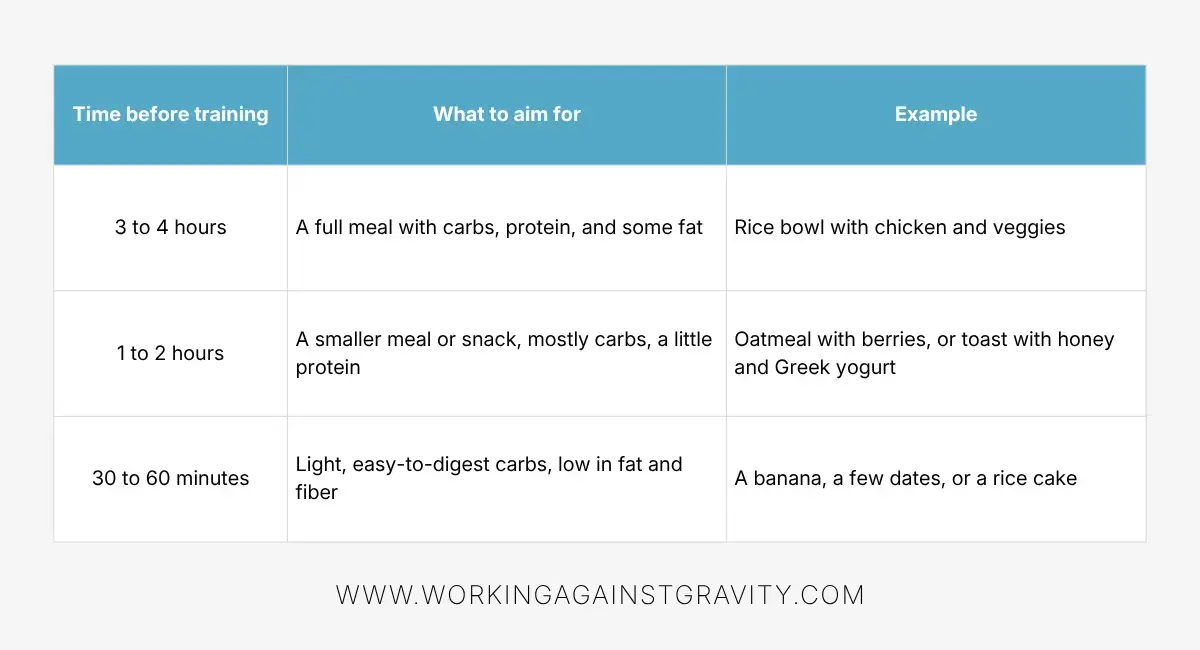
The closer you get to your workout, the more you'll want to cut back on fat, fiber, and protein. Those slow digestion, and gut discomfort during training is common, especially with running and high-intensity work (de Oliveira et al., 2014).
Finally, practice your pre-workout fueling in training, not on race day or competition day. What works for your training partner might not sit well with you.
Common myths and mistakes
"Eating carbs right before training will make you crash." You may have heard that eating carbs in the hour before exercise causes a blood sugar drop that hurts performance. Some people do notice symptoms, but research shows this rebound effect rarely impairs performance for most athletes (Jeukendrup & Killer, 2010). If you're sensitive to it, try eating closer to your warm-up or a bit earlier.
"Carbs are only for endurance athletes." Any athlete doing hard, repeated efforts uses glycogen. Lifters and functional fitness athletes just tend to need less of it around a single session.
"If I'm trying to lose fat, I should cut pre-workout carbs." Fat loss comes down to your overall intake across the day and week. Placing some of your daily carbs around your workouts can help you train harder, which supports your goals rather than hurting them.
Forgetting about the rest of the day. A perfect pre-workout snack won't make up for chronically under-eating carbs. Your day-to-day intake sets the stage for every session.
The bottom line
Pre-workout carbs matter most when your session is long, intense, or early in the morning after an overnight fast. They matter least for shorter lifting sessions when you've eaten normally that day.
A simple way to decide: the longer and harder the workout, and the longer it's been since you ate, the more a pre-workout carb source will help. Start there, pay attention to how you feel and perform, and adjust. Your body's feedback is just as useful as any study.
References:
Burke LM, Hawley JA, Wong SH, Jeukendrup AE. Carbohydrates for training and competition. J Sports Sci. 2011;29(Suppl 1):S17-S27.
Carter JM, Jeukendrup AE, Jones DA. The effect of carbohydrate mouth rinse on 1-h cycle time trial performance. Med Sci Sports Exerc. 2004;36(12):2107-2111.
de Oliveira EP, Burini RC, Jeukendrup A. Gastrointestinal complaints during exercise: prevalence, etiology, and nutritional recommendations. Sports Med. 2014;44(Suppl 1):S79-S85.
Escobar KA, VanDusseldorp TA, Kerksick CM. Carbohydrate intake and resistance-based exercise: are current recommendations reflective of actual need? Br J Nutr. 2016;116(12):2053-2065.
Henselmans M, Bjørnsen T, Hedderman R, Vårvik FT. The effect of carbohydrate intake on strength and resistance training performance: a systematic review. Nutrients. 2022;14(4):856.
Jeukendrup A. A step towards personalized sports nutrition: carbohydrate intake during exercise. Sports Med. 2014;44(Suppl 1):S25-S33.
Jeukendrup AE, Killer SC. The myths surrounding pre-exercise carbohydrate feeding. Ann Nutr Metab. 2010;57(Suppl 2):18-25.
Kerksick CM, Wilborn CD, Roberts MD, et al. ISSN exercise & sports nutrition review update: research & recommendations. J Int Soc Sports Nutr. 2018;15(1):38.
Ormsbee MJ, Bach CW, Baur DA. Pre-exercise nutrition: the role of macronutrients, modified starches and supplements on metabolism and endurance performance. Nutrients. 2014;6(5):1782-1808.
Thomas DT, Erdman KA, Burke LM. American College of Sports Medicine joint position statement: nutrition and athletic performance. Med Sci Sports Exerc. 2016;48(3):543-568.

Schedule a Free Intro Call
Working Against Gravity has led the macro tracking and health space for over a decade. Our team doesn’t just understand the science of nutrition—we’ve spent years mastering the art of tailoring it to fit your life. That means no cookie-cutter plans, just real strategies that have worked for over 30,000 people.
Schedule a free call with our team to learn how working with a 1-on-1 WAG coach will help you reach your goals.
You Might Also Like